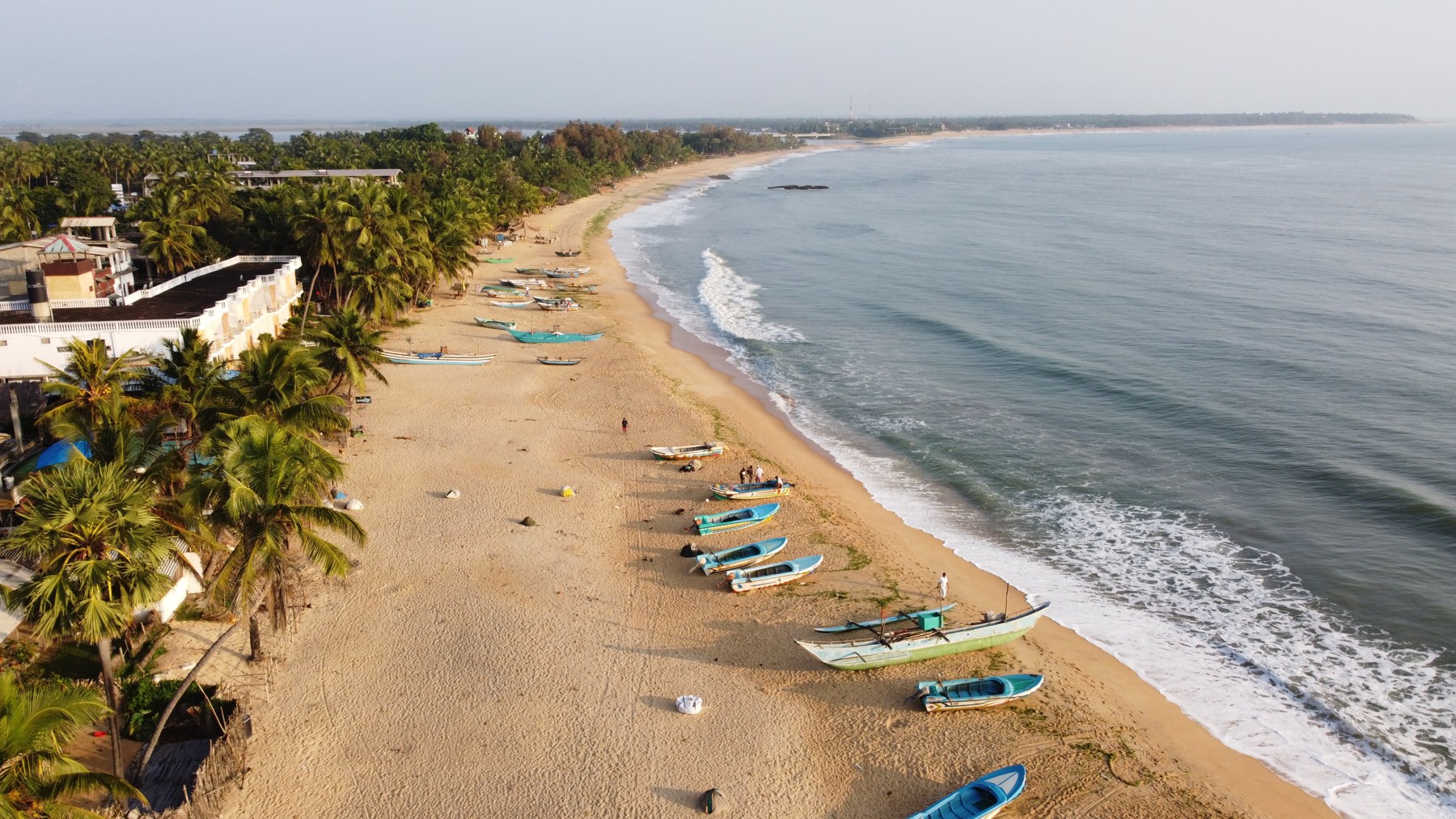

Come to Arugam Bay when you want surfing to give the holiday its rhythm. The right-hand points are the draw, but the stay also has room for a garden pool, a roadside fish dinner and a morning watching Kumana’s wetlands from a jeep. Four to six nights gives you time to learn the breaks rather than chase a different one every day.
This is a surf-first base on Sri Lanka’s east coast. If scuba diving is the reason for your trip, look at Trincomalee and Nilaveli, with a separate travel day rather than a casual excursion from Arugam.
01
Find the wave that fits you
Main Point is the confident surfer’s attraction: a right-hand point over sand and rock, with a line-up that asks for control and awareness. Watching it can be part of the pleasure even when it isn’t your wave. Learners should start with instruction and a beach selected for that day’s conditions; the inside at Baby Point is one possibility. The larger outside wave at Peanut Farm shouldn’t be confused with a sheltered first lesson.
Dylan’s Surf Company is a useful starting choice for instructed beginners and improvers. Its school advertises no more than three students per instructor, with board and rashguard included. A 75-minute beginner lesson costs LKR 5,000 (about US$15); a 150-minute beginner session is LKR 9,000 (about US$27). Transport is extra, including the school’s travel and equipment arrangements, so establish the actual beach and return before the session.
July 2026 family and beginner accounts describe patient teaching, while an improver describes video feedback. That gives the lessons a clearer purpose than simply renting a board and hoping to progress. It doesn’t establish that every break suits a child or a new surfer. Around Elephant Rock, avoid lagoon crossings and informal shortcuts: crocodile exposure makes access a separate consideration from the wave itself.
02
A garden base or a spacious central room
The main strip makes meals and surf arrangements convenient. A room’s position within its property still matters, especially if you want quiet between early starts. Fishing remains part of the coast’s working life; the surf holiday sits alongside it rather than replacing the town with a resort compound.
Hideaway suits readers who want a garden retreat close to the strip. The family-owned property combines heritage rooms, bungalows, verandahs and a pool, with the beach across the road rather than a private frontage. August 2026 visitors praised its setting, meals and service. The appeal is somewhere pleasant to spend the hours when you aren’t surfing.
Its October 2026–June 2027 tariff lists a heritage double with breakfast at about LKR 29,800 (US$90) per room per night, and a double bungalow with breakfast at about LKR 49,700 (US$150). The underlying prices are in dollars, for double occupancy, with taxes and service included. A 3% payment-gateway charge is extra; the 50% deposit is non-refundable, with reuse subject to the property’s conditions. July–September rates and minimum stays differ.
The Spice Trail’s Arugam property, at the 69th Milepost on Panama Road, offers spacious rooms, private-garden bathrooms and a pool. August 2026 guests described clean, roomy accommodation; an earlier long-stay account also noted pool shade and busier moments around it. Compare a dated room quote with the breakfast arrangement you want, and make sure you select Arugam Bay—the company also has an Ahangama property.
03
Fish for dinner, or a table with more variety
Mr Fisherman is on Main Street/Panama Road, with a catch display and seafood meals. Recent diners describe snapper, platters and lobster; some found tuna or squid less successful. Go for the seafood choice and agree the price and portion before it is cooked, rather than expecting a fixed cheap platter or a table on the sand.
Bambini’s Cafe, also on Panama Road, is useful when your group wants different things. Its local and international menu gives a seafood eater and someone wanting a salad or burger a shared dinner plan. A September 2026 couple described prawns and tuna on the balcony; longer-established accounts describe grilled fish and a sociable street-side setting. It’s a meal with some town life around it, rather than a quiet retreat.
04
Trade one surf session for Kumana
A Kumana safari gives companions and tired shoulders a worthwhile change of scene: wetlands, birds and the possibility of larger wildlife. Recent guests on Arugam Bay Tours’ half-day outing describe guides who stopped to identify animals and allowed time to watch them. The morning schedule advertises a 05:00 hotel pickup and 10:30 return; allow roughly five and a half to six hours for the outing, or the afternoon equivalent.
The operator’s table advertises about LKR 24,800 (US$75) per person for two people in a private jeep, including pickup, park entrance and refreshments. Its page also carries a conflicting generic price badge, so get a written total for your group. Arrange breakfast around that early departure, carry water and keep the wildlife watching quiet. Elephants, birds and a possible leopard make an absorbing morning, but sightings remain a matter of luck.
05
When to go
The school’s main season runs April–October, with May–September a useful starting window for planning a surf stay. Conditions change across the shoulders. Dylan’s offers beginner sessions in November–March only when suitable, which isn’t the same as a year-round point-break holiday. An October trip also needs attention to rain and onward transport.
For a suggested five-night stay, settle in on arrival, use two mornings for lessons or surf, then give Kumana a morning of its own. Keep another day flexible for the water, a pool and an unhurried meal. A rest day improves this trip more than another long transfer.
06
Getting here and getting around
From Bandaranaike International Airport, the current local transfer estimate is six to eight hours by road, depending on traffic, weather and arrival time. Treat that as a travel day. Both hotels and local transfer companies advertise prearranged collection; a shared ride needs a confirmed departure rather than an assumed timetable.
Once here, tuk-tuks are useful for outlying breaks. Agree a return as well as the outward journey, and keep transport separate from a lesson’s advertised price. For current rain, flight and fuel disruptions, use the Sri Lanka overview before committing to connections.
Sources and updates
Researched remotely using responsible public guidance, supplier information and substantive traveller accounts. Current source checks: 17 October 2026; September research and older visitor accounts retain their original dates. No field visit, room inspection or operator safety assessment is claimed.
Rupee examples use the Central Bank of Sri Lanka’s 16 October 2026 indicative rates: US$1 = LKR 331.2860 and €1 = LKR 371.6035. Where a supplier advertises in dollars or euros, that tariff controls; conversions are approximate. Room availability for future dates was not checked. Some businesses quote individually or did not publish a usable current tariff, so no universal daily budget is offered.
Photographs identify the actual places and capture dates. Historical photographs do not establish present reef condition, swimming conditions or promised wildlife. Cropped or resized Creative Commons images retain their stated licences.